Search for

Showing posts with label brain. Show all posts

2009-09-22

Natural remedy for brain injury alcohol?

A research team from Cedars-Sinai Medical Center, Los Angeles, studied 38,000 head trauma patients and found that head trauma patients who had drunk alcohol before suffering head injuries seemed less likely to die. They suspect that given the right dose, alcohol stop secondary brain injury (cascade of swelling, inflammation and further destruction of brain cells.

The amount of alcohol consumed seemed important with too little having no effect and too much causing the loss of the beneficial effect, based on animal studies.

Please note that those findings do not imply that one should drink alcohol before driving as alcohol affects reaction time and increases chance of accident. Also, patients with significant levels of alcohol in the blood tend to have medical complications.

The study does suggest the possibility of administering alcohol to brain trauma patients but before that become reality, more researchs need to be done.

Brain trauma at Amazon

2008-04-04

Aging and the brain

Aging

Aging is a natural process as we grow older once we are past a certain age. It is a kind of accepted resignation that one's reaction time may slow with age, memories of recent events may not be as sharp (while surprisingly memories of thing long past may stay vivid in the mind), they may be physical degeneration and medical problems like high blood pressure, heart (cardiovascular) diseases, diabetes, osteoporosis, etc., may start to set in. However, not everyone may age at the same rate.

The Human Brain

human brain
This photo of the brain belongs to Gaetan Lee

The human brain, a three pound slab of soft matters, is a really remarkable organ, perhaps even a miracle. Structurally, the human brain comprises of 2 parts, the left brain and the right brain. The anatomist may divide the brain into three parts: the fore-brain, mid-brain, and hind-brain. We are not scientists and is not here to describe the physical, chemical and biological nature of the brain. Suffice to say that the brain controls many parts and functions of the human body. Let us see if someone else have something to add.

The human brain and aging

The Harvard Gazette says that the aging of the brain starts around the age of 40. The aging process can be a painful process for some, others age gracefully. Some says that the secret is keeping active. There are studies that lifestyle can affect the rate of aging of the brain. Other studies showed restricting the diet also slow the aging process. Still others says "use it or lose it", that is, keep your mind active. In fact, I was told that many Japanese pensioners play mind games to help maintain mental function. More about that later.
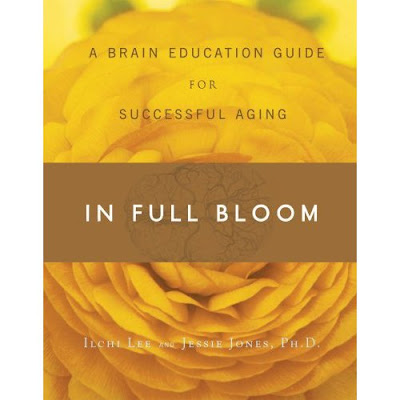
Guide to successful aging

The authors of the above book In Full Bloom: A Brain Education Guide for Successful Aging are Ilchi Lee and Jessie Jones, Ph.D. The site linked to above has useful stuff like Young Brain Quiz if you want to get an idea of how "young" you are, brain wise. There is also a free 14-page downloadable e-book. In addition, there are 4 videos of lectures conducted by Ilchi Lee. I suspect more may be on the way. If that is still not enough, there is also a "Book Club" to help guide you along the reading of the book.

According to "In Full Bloom", most people are disturbed by thoughts of old folks with foggy, confused, useless and forgetful mind plus old age conditions like dementia, Alzheimer’s disease, and Parkinson’s disease. However, you need and should not fear, for there are ways to a vigorous, creative, energetic, improving brain in an aging body. The book says your brain is infinitely adaptable and offers Brain Education System Training (BEST), training which can help you develop your innate human capacities through optimal management of your brain. BEST comprises only 5 steps:

  1. Brain Sensitizing

  2. Brain Versatilizing

  3. Brain Refreshing

  4. Brain Integrating

  5. Brain Mastering


"In Full Bloom" claims that while it is true that genetic heritage can affect the way our brain age, it is only fifteen to thirty percent. The rest is mainly lifestyle choices and behaviors, psychology, environment, and life events, most of which can be controlled. While you cannot choose your age, you can choose a healthy living style.

Mr. Ilchi Lee is Korean, and there is a Korean word "jangsaeng" which can translates as "longevity". However, there is a deeper meaning to the word than just longevity as that is merely a passage of time with no indication of your state of health. The Korean word "jangsaeng" also means living long with a youthful vitality which his book wants to help promote.

2007-02-20

Three ways to brain longevity

According to Dr Dharma Singh Khalsa, president and medical director of the Alzheimer's Prevention Foundation International, Tucson, Arizona. Dr Dharma Singh Khalsa is also author of Brain Longevity (1997), Meditation as Medicine (2002), and Food as Medicine (2004), "your brain needs three different kinds of exercise to thrive best". These are mental exercise, aerobic physical exercise, and mind/body exercises.

Mental Exercise

When you do hard thinking, like when you learn to play the piano, do cross-word puzzles, solve sudoku puzzles, learn new things, brain cells are stimulated to send out microscopic filaments called dentrites to establish new connections with one another. It also stimulate the growth of glial cells which are the brains "housekeepers" that support the metabolism fo cells that do the thinking and keep the brain nerve pathways clean.

Aerobic Exercise

Aerobic exercise increases the blood flow to the brain and that stimulates the release of nerve growth factor, a vital hormone that restores damaged neurons and boosts the levels of the brain's neurotransmitters that the brain needs for thinking and memory. Neurotransmitters are messengers chemicals.

Aerobic exercises are brisk physical activity that requires the heart and lungs to work harder to meet the body's increased oxygen demand. Aerobic exercise promotes the circulation of oxygen through the blood. Examples of aerobic exercise include running, swimming and cycling.

Mind/body exercises

Mind/body exercises are related to ancient Eastern religious practices. "They regenerate the brain by increasing energy levels and boosting the ability to concentrate by 20 per cent or more." Types of this form of exercise include meditation, deep-breathing, and listening to meditative music.

Other factors affecting the longevity of the brain include stress. The brain thrive best when stress-free. Stress causes damage that is slow and subtle and builds up over a lifetime. So try to eliminate stress from your life.

Dr. Khalsa also advocate keeping the fat intake to below 20% of the total calories. Fat promotes brain deterioration just as it promote deterioration of the heart and arteries. It clogs the vessels that carry oxygen and glucose - the brain's energy fuel - to millions of neurons and produces free radicals - the highly reactive and destructive chemicals that scar and kill brain cells.

LinkWithin

Blog Widget by LinkWithin