Search for

Showing posts with label aging. Show all posts

2008-07-01

Olive Oil Prevent Dementia and Alzheimer's disease

Dr Archarna Singh-Manoux, leader of a group researchers from University College London and INSERM (French National Institute for Health and Medical Research or Institut national de la santé et de la recherche médicale) claimed that data from Whitehal II trail (study of thousands of civil servants) people with low level of HDL (high density lipids) or bad cholesterol were 53% more likely to have memory loss as compared to those with high level of HDL (high density lipids)or good cholesterol. People with poor memory tend to be more likely to develop dementia. Dr. Archarna Singh-Manoux said that low HDL cholesterol may be a risk factor for dementia. The reason could be, according to Dr. Susanne Sorenson of the Alzheimer's Society, that HDL cholesterol transport harmful cholesterol from the arteries back to the liver to be degraded to simpler substances to be excreted.

Anything connected with Olive Oil

It is thus possible that a diet high in olive oil which have HDL cholesterol may help prevent Dementia and Alzheimer's Disease.

books on olive oil

2008-04-04

Aging and the brain

Aging

Aging is a natural process as we grow older once we are past a certain age. It is a kind of accepted resignation that one's reaction time may slow with age, memories of recent events may not be as sharp (while surprisingly memories of thing long past may stay vivid in the mind), they may be physical degeneration and medical problems like high blood pressure, heart (cardiovascular) diseases, diabetes, osteoporosis, etc., may start to set in. However, not everyone may age at the same rate.

The Human Brain

human brain
This photo of the brain belongs to Gaetan Lee

The human brain, a three pound slab of soft matters, is a really remarkable organ, perhaps even a miracle. Structurally, the human brain comprises of 2 parts, the left brain and the right brain. The anatomist may divide the brain into three parts: the fore-brain, mid-brain, and hind-brain. We are not scientists and is not here to describe the physical, chemical and biological nature of the brain. Suffice to say that the brain controls many parts and functions of the human body. Let us see if someone else have something to add.

The human brain and aging

The Harvard Gazette says that the aging of the brain starts around the age of 40. The aging process can be a painful process for some, others age gracefully. Some says that the secret is keeping active. There are studies that lifestyle can affect the rate of aging of the brain. Other studies showed restricting the diet also slow the aging process. Still others says "use it or lose it", that is, keep your mind active. In fact, I was told that many Japanese pensioners play mind games to help maintain mental function. More about that later.
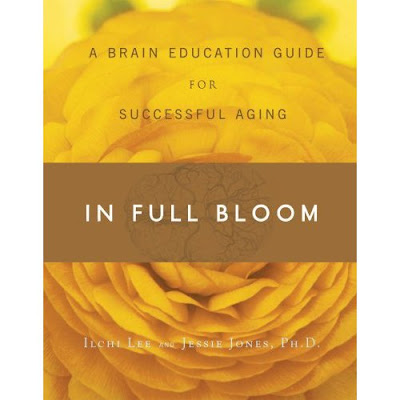
Guide to successful aging

The authors of the above book In Full Bloom: A Brain Education Guide for Successful Aging are Ilchi Lee and Jessie Jones, Ph.D. The site linked to above has useful stuff like Young Brain Quiz if you want to get an idea of how "young" you are, brain wise. There is also a free 14-page downloadable e-book. In addition, there are 4 videos of lectures conducted by Ilchi Lee. I suspect more may be on the way. If that is still not enough, there is also a "Book Club" to help guide you along the reading of the book.

According to "In Full Bloom", most people are disturbed by thoughts of old folks with foggy, confused, useless and forgetful mind plus old age conditions like dementia, Alzheimer’s disease, and Parkinson’s disease. However, you need and should not fear, for there are ways to a vigorous, creative, energetic, improving brain in an aging body. The book says your brain is infinitely adaptable and offers Brain Education System Training (BEST), training which can help you develop your innate human capacities through optimal management of your brain. BEST comprises only 5 steps:

  1. Brain Sensitizing

  2. Brain Versatilizing

  3. Brain Refreshing

  4. Brain Integrating

  5. Brain Mastering


"In Full Bloom" claims that while it is true that genetic heritage can affect the way our brain age, it is only fifteen to thirty percent. The rest is mainly lifestyle choices and behaviors, psychology, environment, and life events, most of which can be controlled. While you cannot choose your age, you can choose a healthy living style.

Mr. Ilchi Lee is Korean, and there is a Korean word "jangsaeng" which can translates as "longevity". However, there is a deeper meaning to the word than just longevity as that is merely a passage of time with no indication of your state of health. The Korean word "jangsaeng" also means living long with a youthful vitality which his book wants to help promote.

2007-10-14

Memory Loss Pevention for Older Women

Memory loss as one grows old may sound like an inevitable problem, but I believe there are ways to help prevent, or at least, greatly slow that down. The way I do it is to keep my brain active by blogging which is now my hobby and is something I enjoy. It is now hard to imagine to be without an Internet connection. But here is a video that says a study showed 3 coffee (I assume what they meant is 3 cups of coffee) a day can keep memory loss at bay for older women. Wonder if that works for men as well.

2005-10-04

Exercise to keep dementia at bay

Want to avoid getting dementia in your later years? Exercise! Do physical activities which last 20-30 minutes at least twice a week and which is enough to cause breathlessness and sweating.

Dr Miia Kivipelto and colleagues studied 1,500 men and women, of whom nearly 200 developed dementia or Alzheimer's disease between the ages of 65 and 79. The researchers looked back at how physically active the study participants had been up to 21 years earlier, when they would have been in their late 40s and early 50s. Those who developed Alzheimer's disease or another form of dementia were far less likely to have been active when they were middle-aged than those who remained free of dementia.

Reasons why regular exercise might be good for the brain include exercise helping to keep the small blood vessels of the brain healthy, protecting against other conditions such as high blood pressure and diabetes that might make dementia more likely, reducing the amount of protein amyloid that builds up in the brain in Alzheimer's disease.

Exercise now to cut dementia risk. BBCNews.

Exercise Keeps the Old Mind Healthy

iRobot Roomba 4100/4300 Intelligent Floorvac Robotic Vacuum, Red

iRobot Roomba 4210 Discovery Floorvac Robotic Vacuum, White

iRobot 5900 Scooba Floor Washing Robotic Hard Surface Cleaner

2005-09-29

Exercise may prevent pain in older adults

Dr. Bonnie Bruce of Stanford University, Palo Alto, California, said that running and other forms of vigorous exercise may prevent some of the aches that come with age. In a study of 866 healthy adults age 50 and over, Dr. Bruce and her researchers found that those who exercised regularly were less likely to develop painful joints and muscles over the next 14 years, with the active adults' pain-rating scores consistently 25% lower than their peers despite them being more likely to have a history of bone fracture. Sedentary peers had a higher rate of arthritis. Reuters Health

LinkWithin

Blog Widget by LinkWithin